


posted 8th April 2026
By Jon Shaw, Ironman Certified Coach, ESCI Certified Coach Your Coach page
This is the definitive guide to the longest-running debate in the transition area. At Infinite Endurance, we don’t look at metrics in isolation. We look at them as a conversation. If you aren’t listening to what your Heart Rate is telling your Power Meter, you’re missing the most important data point of all: The Truth.
In the world of Ironman triathlons, we are obsessed with "The New." We want the latest carbon-plated shoes, the most aerodynamic hydration systems, and, most of all, the most precise data.
For years, the debate has been binary. The "Old Guard" swears by Heart Rate (Internal Load)—the physiological cost of the work. The "New Guard" swears by Power (External Load)—the objective output of the work.
But as an athlete over 35, balancing a high-stress career with a 12-hour training week, choosing one over the other is a strategic error. To build an Infinite Chassis, you must understand that Power tells you what you are doing, but Heart Rate tells you what it is costing you.
If you want to win your next Ironman—whether that’s a podium or a massive PB—you need to stop choosing a side and start mastering the Decoupling.
Power — The Brutal Honesty of External Load
Power is the king of the "New Age" of cycling and, increasingly, running. Measured in Watts (W), power is objective. It is the absolute measure of work being performed at any given second.
Why Power Wins:
- 1. Zero Lag: Unlike Heart Rate, which can take 30–60 seconds to "catch up" to an interval, Power is instantaneous. If you hit a hill, you see the surge immediately.
- 2. Environmental Immunity: Power doesn't care if it’s 30°C or 5°C. It doesn't care if you had three espressos or a fight with your boss. 250W is 250W.
- 3. The "Ego" Check: Power prevents "Intensity Creep." It stops you from pushing too hard on the first half of the Ironman bike leg when your legs feel like million-pound pistons.
The Danger:
The "Power Slave" often ignores the internal changes. If your plan says to hold 200W, but your body is fighting a virus or extreme heat, holding that 200W might be digging you into a hole that you can't climb out of during the marathon.

Heart Rate — The Biological Whisper of Internal Load
If Power is the speed of the car, Heart Rate (HR) is the temperature gauge of the engine. It measures the physiological strain required to produce that power.
Why Heart Rate Wins:
- 1. Context is Everything: HR accounts for the variables that Power ignores: heat, dehydration, fatigue, and cardiac drift.
- 2. Safety Valve: HR is your early warning system. If your HR is 15 beats higher than normal for a given power output, your "Internal Load" is too high. Your body is screaming "Slow down" before your legs even feel the burn.
- 3. The Masters Advantage: For the 35+ athlete, HR is the best metric for monitoring Metabolic Flexibility. It indicates when you’ve shifted from burning fat to burning through your precious, finite glycogen stores.
The Danger:
HR is "noisy." It is affected by caffeine, lack of sleep, and race-day nerves. If you pace purely by HR, you might under-perform because of "taper madness" adrenaline.
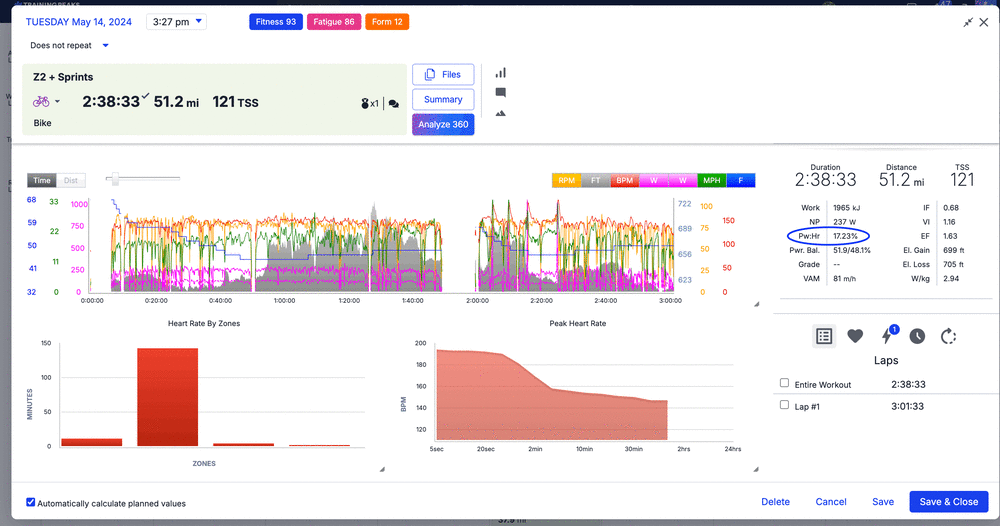
The Secret Metric — Aerobic Decoupling (Pw:Hr)
This is where Infinite Endurance athletes find their edge. We don't just look at P or HR; we look at the relationship between them. This is known as Aerobic Decoupling.
In a perfectly fit, "Bullet-Proof" athlete, Power and Heart Rate should stay "coupled" for the duration of the event. If you hold 200W for four hours, your HR should remain relatively stable.
However, as fatigue sets in, the heart has to work harder to maintain the same power. This is "Decoupling." We calculate this using the following ratio:
Decoupling % = (Power (First Half) \ HR (First Half) \ Power (Second Half) / HR (Second Half)) – 1
The 5% Rule:
- < 5% Decoupling: You are aerobically fit for the duration. Your chassis is resilient. You have "permission" to push.
- 5% Decoupling: Your aerobic engine is failing. Your "Internal Load" is rising faster than your output. If this happens in the first half of your bike leg, you are going to "explode" on the run.
The Masters Athlete’s Guide to Race Day Pacing
For the 35+ executive athlete, race day is a game of Resource Management. You have a finite tank of glycogen and a heart that is more sensitive to stress than it was at 22.
1. The Bike: Power is the Ceiling, HR is the Redline
On the bike, use Power as your primary guide, but use HR as your "Consultant."
- The Strategy: Set a Power Ceiling (e.g. 70% of FTP). No matter how good you feel, do not cross it.
- The Adjustment: If you hit the second half of the bike and your HR starts climbing into Zone 4 while your Power is still in Zone 2/3, ignore the power meter. Drop your watts until your HR stabilises. Your run will thank you.
2. The Run: The "Central Governor" Takeover
On the run, Power (via Stryd or Garmin) is useful, but HR and RPE (Rated Perceived Exertion) become the masters.
- Why? Because by the marathon, your "Structural Resilience" is the limiting factor. Your heart rate will likely stay high due to "Cardiac Drift," but your pace will drop.
- The Strategy: Use the Mental Operating System frameworks we discussed. Chunk the race. Monitor HR to ensure you aren't "redlining" before the final 10k.
How We Monitor This in TrainingPeaks
At Infinite Endurance, I don't just give you a PDF and wish you luck. I use TrainingPeaks to watch these two metrics interact in every single session.
The Feedback Loop:
- 1. The "Whisper" Check: If I see your HR is high for a "Zone 2" recovery run, I know your 48-Hour Recovery Blueprint is being ignored. I will pivot your 9-day cycle immediately.
- 2. Efficiency Factor (EF): I track your EF (Normalised Power divided by Average Heart Rate) over months. If your EF is rising, you are becoming more "Infinite"—you are producing more power for less physiological "cost."
- 3. The "Injury Tax" Warning: A sudden spike in HR for a standard power output is often the first sign of overtraining or an impending niggle. We see it in the data before you feel it in your legs.
The Verdict — Who Wins?
Which metric wins your next Ironman? Neither. The Athlete who integrates them wins.
- Use Power to build the engine and keep your ego in check during the first half of the race.
- Use Heart Rate to monitor the "cost" of that power and ensure you aren't burning your "Infinite" fat stores too early.
The "Infinite" athlete understands that data is not a cage; it is a map. It allows you to make objective decisions in a subjective environment.
Conclusion: Don't Guess. Execute.
If you are a 35+ athlete tired of "bonking" or watching your pace collapse in the final 10 miles of an Ironman, it’s time to move beyond simple pacing. You need a system that balances External Output with Internal Resilience.
I take the complex data of Power and HR and turn it into a simple, executable blueprint for my clients. I manage the "How" so you can focus on the "Execution."
Ready to Master Your Metrics?
Stop the guesswork. If you're ready to see what your data is actually trying to tell you, I’m here to help.
[Click Here to Apply for a Free 15-Minute Performance Audit]Contact Us page