posted 14th April 2026
By Jon Shaw, Ironman Certified Coach, ESCI Certified Coach Your Coach page
There can be a funny kind of soul-crushing frustration we all go through as triathletes who, after hammering out what they thought was a hot 1,500m swim, climbs out of the water to find their GPS watch reads 1,850m.
You didn’t get faster; you just took the "scenic route."
Swimming straight in open water is arguably the most underrated skill in endurance sports. You can have the aerobic capacity of an ox and the stroke of an Olympian, but if you’re zig-zagging across the lake, you are wasting precious energy and time. Gain a performance advantage over your fellow competitors and learn this technical skill.
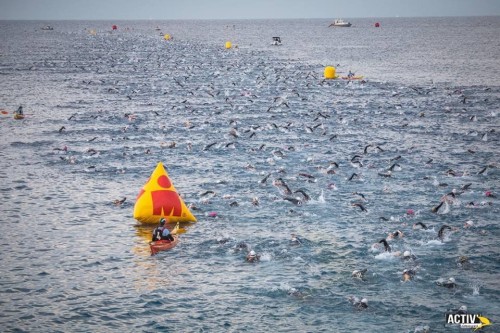
This deep dive is designed to turn you into a human laser beam. We will break down the mechanics of sighting, the physics of why you veer, and the tactical strategies used by the pros to navigate the "washing machine" of race day. Ultimately if you don’t practice it in training then you won’t perform in the middle of 1500 other triathletes.
Why You Don’t Swim Straight : The Physics of the Veer
Before we fix the problem, we need to understand the "why." Most swimmers have a natural "drift." In a pool, the black line and the lane ropes act as a subconscious corrective tool. In open water, those training wheels are gone.
The Asymmetrical Stroke
Most humans are not perfectly symmetrical. You more than likely have a dominant side, a slightly stronger pull on the right, or a tendency to "cross the midline" with your left hand. In a pool, you adjust for this every 25 meters. In the ocean, a 2-degree deviation over 400 meters can put you 20 meters off course. An uneven kick or rotation will also pull you off course.
The Breathing Trap
If you are a unilateral breather (only breathing to one side), you are highly likely to be veering. As you rotate to breathe, your lead arm often "fishes" outward to provide balance, or your hips fishtail in the opposite direction. This creates a subtle curve in your path that compounds over thousands of strokes.
The "Head-Lift" Anchor
When you lift your head too high to look for a buoy, your hips and legs immediately drop. This creates massive drag, slowing you down and making you more susceptible to being pushed off course by wind or current.
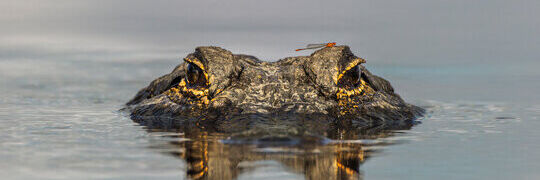
Mastering the "Crocodile Eyes" Sighting Technique
The most common mistake in open water is the "Pop-up." This is where the swimmer lifts their entire head out of the water, stops their momentum, and looks around like a confused meerkat.
Instead, you want to use Crocodile Eyes.
The Sequence:
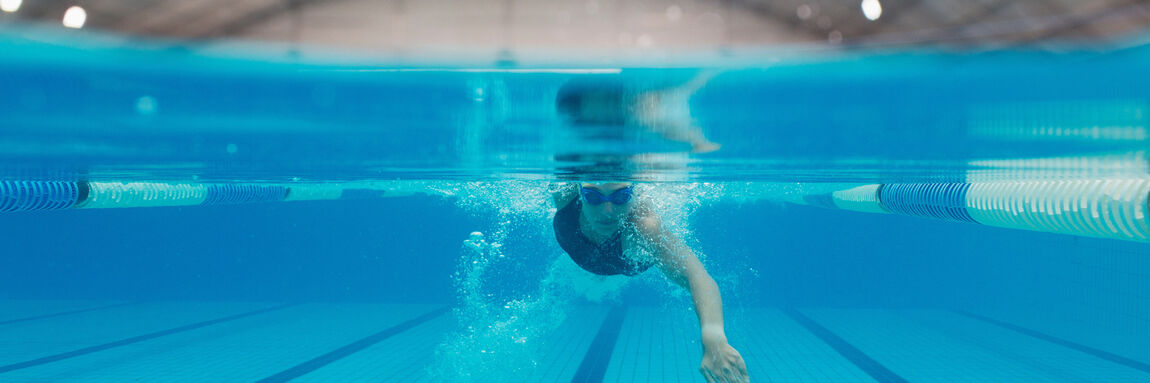
- The Look: As your hand enters the water and begins the "catch" phase, lift your eyes just enough to clear the surface—think Goggles-only. You don't need to see the buoy's logo; you just need to see the colour.
- The Breath: Do not breathe while looking forward. Looking forward and breathing at the same time is the fastest way to swallow a mouthful of lake/sea water and sink your hips. After you’ve "sighted," turn your head to the side to breathe normally as part of your natural rotation.
- The Integration: Sighting should be a seamless part of your stroke, not a separate event.
Pro Tip: If the water is choppy, time your sighting for the "crest" of a wave. If you sight from the "trough," all you'll see is a wall of water. Think: “peek, don’t look”
Advanced Navigation : Using Landmarks and the Sun
If you only look for the buoy, you’re making life hard for yourself. Buoys can be small, they bob up and down, and they are often obscured by 50 other swimmers. To swim straight, you need a "Macro" and "Micro" navigation plan.
Use "Stationary" Landmarks
Look past the buoy. Is there a giant pine tree on the horizon? A colourful house? A specific mountain peak? These are much easier to spot than a 4-foot orange pyramid. Align the buoy with a massive, unmoving object on the shore.
The Sun as a Compass
On a clear day, the sun is your best friend. If the sun is at your 10 o'clock position when you start, and you suddenly feel it hitting your right shoulder, you’ve veered off course. You can "sense" the sun’s position through your goggles even without looking directly at it.
Back-Sighting
When swimming away from the shore, look back occasionally. If the swim start arch is directly behind you, you’re good. If it’s shifted to the left, you’ve drifted right.
The "Ferry Glide" (Dealing with Currents)
If there is a strong cross-current, aiming directly at the buoy will result in you being swept downstream, forcing you to swim a "banana" curve. Instead, aim slightly "upstream" of the buoy. It feels counter-intuitive, but the current will push you into the correct position, allowing you to swim a straight diagonal line.
Pool Drills to Fix Your Open Water Direction
You don't need a lake to practice swimming straight. You can diagnose and fix your "drift" in a standard 25-meter lane.
The "Eyes Closed" Drill
This is the ultimate test.
- 1. Ensure you have a lane to yourself (safety first!).
- 2. Push off the wall, get into your rhythm, and close your eyes.
- 3. Swim 15–20 strokes or until you feel yourself hit a lane rope.
- 4. Whichever rope you hit tells you which way you naturally veer.
Sighting Drills
Incorporate sighting into every pool workout. Practice "Crocodile Eyes" every 4th length. Try to see the pace clock or a water bottle at the end of the lane without disrupting your stroke rhythm.
The Water Polo Drill
Swim 25 meters with your head completely out of the water (looking forward). This is exhausting, but it builds the neck and upper back strength required to sight effectively when you're fatigued in the second half of an Ironman swim.
Race day Intensity
Most athletes practice the skills at an easy pace in calm conditions. This just does not translate to race day scenarios. You need to practice sighting along with drafting at race pace and in race day conditions with other swimmers around you. Remember if it isn’t trained under stress then it won’t show up on race day.
Using the pool to iron out your navigation issues is one of the most effective ways to save time on race day. Here is a breakdown of those drills organized for your training log.
Pool Drills to Fix Open Water Direction
| Drill Name | Execution | Primary Goal | Diagnostic Insight |
|---|---|---|---|
| Eyes Closed Drill | Push off and swim 15–20 strokes with eyes closed (ensure lane is clear) | Identify natural "drift" or stroke imbalance | If you hit the left rope, your right-side pull is likely dominant |
| No-Breath Swimming | Swim 15–25m intervals without taking a breath | Focus on total body symmetry and a straight pull | If you stay straight here but veer when breathing, your neck/hip rotation is the culprit |
| Bilateral Breathing | Alternate breathing sides every 3, 5, or 7 strokes | Build a balanced, symmetrical stroke | Reduces the tendency to "swing" wide on your non-dominant breathing side |
| Pool Sighting | Lift eyes (goggles only) to look at the wall every 6–8 strokes | Build sighting into your regular stroke rhythm | Teaches you to sight without dropping your hips or stopping momentum |
Implementation Tip:
Try adding these to your warm-up or cool-down. For example, a 4 x 50m Sighting Set where you sight twice per length is an easy way to make navigation "muscle memory" without sacrificing your main meterage sets.
Essential Gear: Polarised Goggles and Wetsuit Fit
Sometimes, swimming straight is a matter of optics. If you can’t see, you can’t navigate.
- Polarised Goggles: These are non-negotiable for open water. They cut the glare off the water’s surface, allowing you to actually see the buoys and landmarks rather than just a shimmering white hole.
- Anti-Fog is Your Best Friend: Use a dedicated anti-fog spray or the "spit and rinse" method. If your goggles fog up 200m in, your navigation is going to be tough.
- The Wetsuit Fit: A wetsuit that is too tight in the shoulders will cause you to "short-stroke" on one side, leading to veering. Ensure you pull the sleeves up high enough to allow for a full, symmetrical range of motion.
Pacing and Sighting Frequency
How often should you sight? There is no "one size fits all" answer, but there is a logic to it.
| Water Conditions | Sighting Frequency | Reason |
|---|---|---|
| Glassy/Flat | Every 10–12 strokes | High visibility; low risk of drift |
| Moderate Chop | Every 6–8 strokes | Wind and waves will push you off course |
| High Surf/Current | Every 4 strokes | Frequent corrections needed to stay on line |
| Crowded Start | Every 2–4 strokes | To avoid swimming over (or being swam over) by others |
The Psychology of Staying Straight
Finally, there’s the mental aspect. When you’re in the middle of a big body of water, it’s easy to feel disoriented. Panic causes "Head-Lifting," and "Head-Lifting" causes bad form.
Trust Your Sighting
If you sight and see that you are on course, trust it. Don't sight again three strokes later just out of anxiety. Trusting your line allows you to put your head down and focus on the power of your pull.
Follow a "Leader" (With Caution)
Drafting is a great way to save energy but never assume the person in front of you knows where they are going. They might be a strong swimmer but poor with their sighting. Periodically sight for yourself to verify that your "lead boat" isn't leading you in a different direction.
Summary: The Straight-Line Checklist
To summarise, here is your pre-race mental checklist for a laser-straight swim:
- 1. Identify a "Mega-Landmark" behind the buoy.
- 2. Check the Sun and wind direction.
- 3. Use "Crocodile Eyes" to sight without dropping the hips.
- 4. Breathe to the side, never to the front.
- 5. Audit your stroke—is your "catch" symmetrical?
- 6. Trust but verify the person you are drafting.
- 7. Train the skill at intensity not just in a calm easy environment.
Swimming 3.8km is hard enough. Don't make it 4.2km just because you didn't want to look up. Master the art of the straight line, and you'll find yourself reaching T1 fresher, faster, and much closer to the front of the pack.
Happy swimming—and keep those eyes on the horizon!
How has your open water navigation been lately? Are you a "one-side veerer" or do you have the "crocodile eyes" technique down to a science?
Ironman Coaching page