


posted 24th March 2026
By Jon Shaw, Ironman Certified Coach, ESCI Certified Coach Your Coach page
Stop the "late-race fade." Learn the 48-hour recovery blueprint How Long Does it Really Take to Recover? The 48-Hour Blueprint for Endurance Athletes article, the "Big Five" strength exercises The Minimum Effective Dose: 5 Strength Moves Every Runner Ignores article, and the 9-day training cycle used by elite amateurs to build an "Infinite Chassis" Infinite Performance: How to Master Muscular Endurance for the Amateur Athlete articleand improve running economy.
For the endurance athlete, the word "endurance" usually evokes images of the heart and lungs—a powerful cardiovascular engine capable of pumping oxygen-rich blood to working muscles for hours on end. We focus on VO2 max, threshold intervals, and long, slow distance.
But there is a silent partner in this equation: Muscular Endurance (ME).
You can have the biggest aerobic engine in the world, but if your "chassis"—the muscles, tendons, and ligaments—cannot handle the repetitive force of 40,000 foot-strikes in a marathon or 30,000 pedal strokes in a century ride, your engine will eventually tear your frame apart. At Infinite Endurance, we define Muscular Endurance not just as the ability to keep going, but as the ability to sustain force production in a state of fatigue.
In this deep dive, we will deconstruct the physiology of muscular endurance for the amateur athlete and provide a high-precision blueprint to build a body that doesn't just survive the distance but conquers it.

The Physiology of the "Infinite Chassis"
To improve muscular endurance, we must first understand what is happening at the cellular level. Muscular endurance is the bridge between raw strength (one-rep max) and aerobic capacity (VO2 max).
The Fiber Type Shift
Humans have two main types of muscle fibres: Type I (Slow-Twitch) and Type II (Fast-Twitch).
- Type I fibres are the endurance workhorses. They are packed with mitochondria and are highly resistant to fatigue.
- Type II fibres are for power and speed but burn out quickly.
The goal of the endurance athlete is efficiency. Through specific strength and endurance training, we can actually encourage "fibre type shifting," where Type IIx fibres (purely explosive) become more like Type IIa fibres (hybrid), which can utilise oxygen more efficiently. This gives you a "reserve tank" of power for hills and final sprints without the high metabolic cost of pure explosive movement.
Mitochondrial Density and Capillarisation
Muscular endurance is limited by how quickly a muscle can receive oxygen and clear metabolic byproducts (like hydrogen ions).
- Capillarisation: High-repetition, low-intensity training increases the network of tiny blood vessels surrounding your muscle fibres. More "roads" mean more oxygen delivered to the "factory."
- Mitochondrial Biogenesis: Proper strength training increases the number and size of mitochondria—the power plants of the cell. This allows you to burn fat more efficiently at higher intensities, sparing your precious glycogen for the final miles.
Neuromuscular Efficiency
Muscular endurance is as much about the brain as it is about the legs. As you fatigue, your brain’s ability to "fire" muscle fibres decreases. This is the Central Nervous System (CNS) fatigue we discussed in the 48-Hour Recovery Blueprint. Improving ME involves training the brain to recruit muscles more efficiently even when the "battery" is low.
The Strength Connection – Heavy Lifting for Endurance
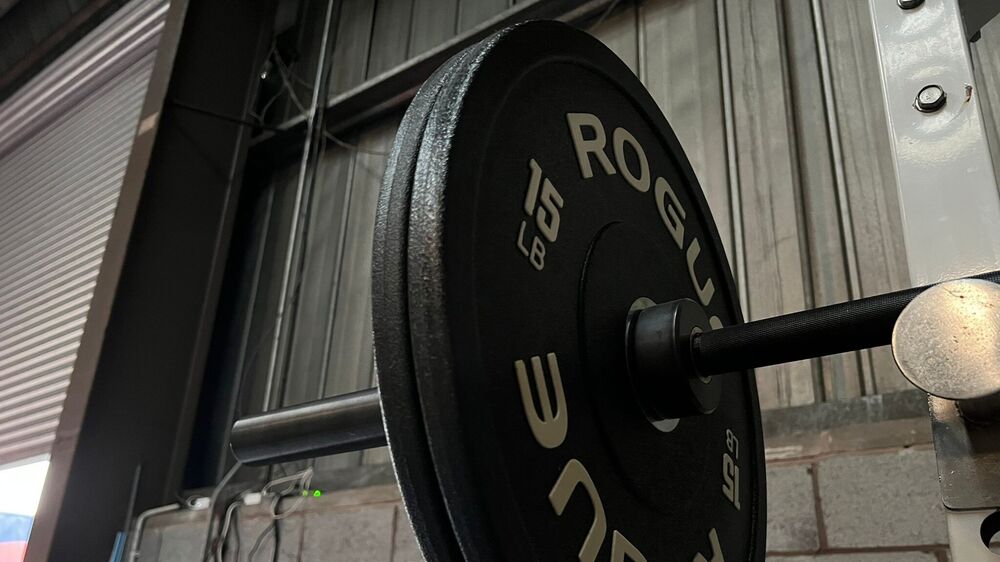
One of the most damaging myths in amateur endurance sports is that "runners shouldn't lift heavy weights because they will get too bulky."
As we detailed in our Minimum Effective Dose guide, strength training for endurance isn't about hypertrophy (size); it’s about Running Economy (RE). RE is a measure of how much oxygen you consume at a given pace. If your muscles are stronger, each stride represents a smaller percentage of your maximum strength.
The "Stiff Spring" Effect
Think of your tendons like springs. A stronger muscle creates a "stiffer" tendon. When your foot hits the ground, a stiff tendon stores more elastic energy and "snaps" back more forcefully. This is "free" energy. If your muscular endurance is low, your "springs" become "mushy" by Mile 20, and you have to work significantly harder just to maintain the same pace.
The "Big Five" for Muscular Endurance
To build this durability, we focus on unilateral (single-leg) movements. Why? Because running is essentially a series of thousands of single-leg hops. If you only squat with two legs, you never train the pelvic stability required for the marathon.
- Rear-Foot Elevated Split Squat (RFESS) : Builds the "quad-glute" engine while stretching the hip flexors.
- Single-Leg Romanian Deadlift (SLRDL) : The gold standard for hamstring and lower back durability.
- Soleus Wall Sit : Protects the Achilles tendon—a common "niggle" for the 40+ athlete.
- Copenhagen Plank : Stabilises the adductors and prevents the IT band issues that sideline 70% of runners.
- Weighted Step-Ups : Specifically builds the vertical power needed for hills.
The 9-Day Cycle – Programming for the Amateur
For the amateur athlete balancing a career and family, the traditional 7-day training week often leads to a "plateau of exhaustion." To master muscular endurance, we advocate for the 9-Day Microcycle.
This cycle allows for the Supercompensation phase to actually occur. If you do a hard muscular endurance session on Monday and try to do track intervals on Tuesday, you aren't building endurance; you're just accumulating debt.
A Sample Muscular Endurance Integration:
- Day 1: High-Intensity Intervals (The Engine)
- Day 2: Easy Recovery / Pre-Hab (The Maintenance)
- Day 3: Heavy Strength Session (The Chassis)
- Day 4: Zone 2 Aerobic (The Base)
- Day 5: Active Recovery (The Flush)
- Day 6: Muscular Endurance "Sport Specific" (e.g., Hill Repeats or Big Gear Bike Intervals)
- Day 7: Easy Recovery
- Day 8: The Long Run/Ride (The Integration)
- Day 9: Full Rest
By spacing the Heavy Strength (Day 3) and the Sport-Specific ME (Day 6), you give your Central Nervous System enough time to recover, ensuring that when you do work, the quality is high.

Sport-Specific Muscular Endurance
Gym work builds the "potential" for endurance, but you must convert that potential into "kinetic" performance on the road or trail.
The Hill Repeat (The "Gym on the Road")
Hills are the most effective way to build sport-specific muscular endurance. They force a higher muscle fibre recruitment than flat running.
- The Workout: 6–8 x 3-minute hills at a moderate grade. Focus on "driving" through the glutes rather than sprinting. This builds the ability to produce force against resistance.
Low-Cadence/Big Gear Work (Cycling)
For cyclists and Ironman triathletes, muscular endurance is often limited by "leg speed."
*The Workout*: 4 x 10 minutes in a "Big Gear" at 50–60 RPM. This places a massive torque demand on the muscles without red-lining the cardiovascular system. It builds the "muscular resilience" needed for the final 40km of an Ironman bike leg.
Drag Sets (Swimming)
Swimming with a "pull buoy" or "paddles" increases the resistance of the water. This builds the muscular endurance in the lats and shoulders required to maintain a high "catch" when the heart rate is elevated.
Nutrition and the "Metabolic Reset"
You cannot build muscular endurance in a caloric deficit. To repair the micro-trauma caused by heavy lifting and long-distance training, the amateur athlete must overcome Anabolic Resistance, especially after age 40.
- The Protein Anchor : Aim for 1.6g to 2.g of protein per kilogram of body weight. This provides the amino acids necessary to rebuild the muscle fibres you’ve strategically torn down.
- Beta-Alanine : One of the few scientifically proven supplements for muscular endurance. It helps buffer the "burn" (hydrogen ions) in the muscles, allowing you to sustain a higher intensity for longer.
- The 4:1 Ratio : Post-workout, use the 48-Hour Blueprint rule: a 4:1 ratio of carbohydrates to protein within 30 minutes to flip the switch from catabolic (breaking down) to anabolic (building up).
The Mental Operating System
Finally, we must address the "Central Governor." As we explored in our Final 10k of the Marathon guide, muscular endurance is often limited by your brain’s perception of pain.
When your legs begin to "burn" at Mile 22, it isn't necessarily because the muscles are failing; it's because your brain is trying to protect you.
- Associative Focus : Instead of trying to distract yourself from the fatigue, lean into it. Perform a "10-point scan." Check your jaw, your shoulders, and your foot strike.
- Cognitive Reframing : Reframe the muscular "burn" not as an emergency, but as "high-intensity recruitment." It is the feeling of your body accessing those hybrid Type IIa fibres to get you to the finish line.
Conclusion: Building an Infinite Performance System
Improving muscular endurance isn't about doing more miles; it’s about doing better miles supported by a stronger frame. It requires the discipline to lift heavy, the patience to recover for 48 hours, and the wisdom to follow a 9-day cycle that respects your "real-world" schedule.
At Infinite Endurance, we don't just give you a "workout plan." We provide a Performance System. We handle the complex data analysis, the planning of your "Minimum Effective Dose" strength work, and the tracking of your recovery metrics.
We take over the "How" so you can focus on the "Why."
Stop the Fade. Start the Breakthrough.
Are you tired of your legs giving out before your lungs do? Are you sidelined by "niggles" every time you try to increase your volume? It’s time to move away from the "injury-and-burnout" cycle and toward a precision-engineered muscular endurance system.
[Click Here to Apply for a Free 15-Minute Performance Audit]Contact Us page
Let’s look at your current "chassis" and build a plan that lasts a lifetime.