


posted 11th February 2026
By Jon Shaw, Ironman Certified Coach, ESCI Certified Coach Your Coach page
The Minimum Effective Dose: 5 Strength Moves Every Runner Ignores
Unlock your peak running performance with our 'Minimum Effective Dose' strength guide. Master the 5 essential exercises every runner ignores to improve running economy, prevent injuries, and build long-term durability. Perfect for time-crunched athletes looking for high-impact results in just 30 minutes, twice a week.
Being honest with ourselves, strength training for runners is like a chore we "forget" to do. We’d rather spend an extra 30 minutes grinding out another 5k. I get it. The gym feels heavy, static, and boring compared to the open road.
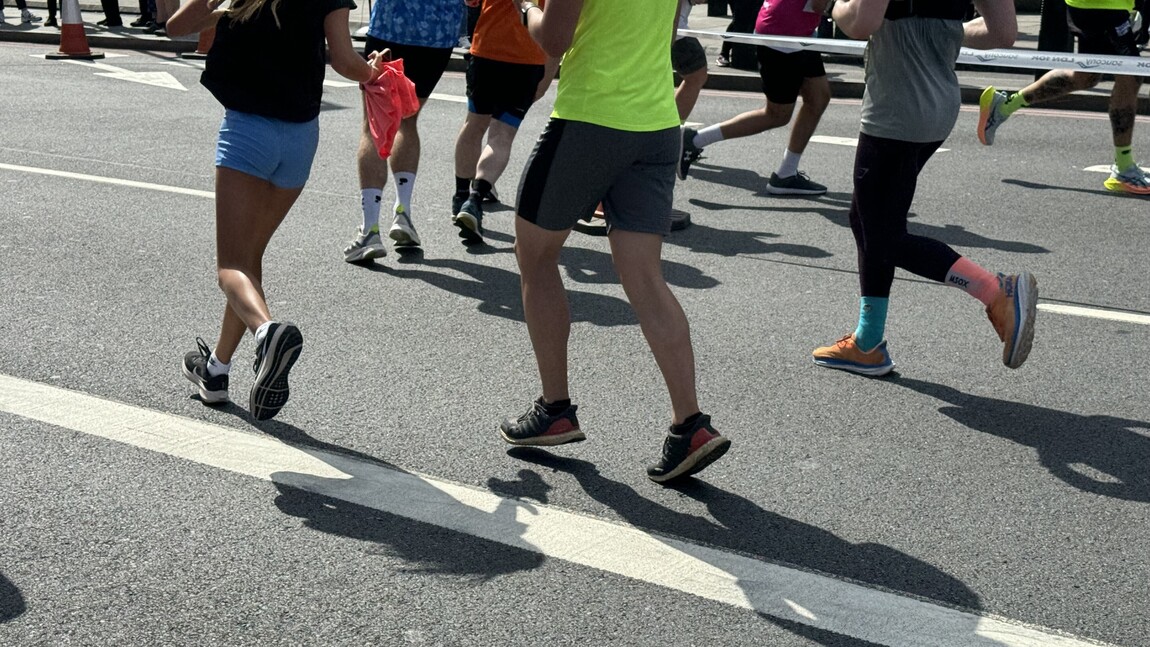
But here is the hard truth: Running is a series of single-leg plyometric hops. Every time your foot strikes the pavement, you are absorbing between 3× to 5× your body weight in impact forces. If your "chassis" (your musculoskeletal system) isn't strong enough to handle those forces, your "engine" (your aerobic capacity) will eventually tear it apart.
The goal of this "Minimum Effective Dose" is not to get "buff." It is to improve your Running Economy (RE). RE is a measure of how much oxygen you consume at a given pace. Stronger muscles and stiffer tendons allow for better elastic recoil, meaning you get "free" energy with every stride. Single-leg exercises
The "Big Five" Exercises for Durability & Economy
1. Rear-Foot Elevated Split Squat (RFESS)
• The "Why": Running is a unilateral sport. You are never on two feet at the same time. Therefore, training with two feet on the ground (like a standard barbell squat) is less specific to your needs. The RFESS—often called the Bulgarian Split Squat—forces the lead leg to stabilize the hip, knee, and ankle simultaneously.
• The Benefit: It targets the gluteus medius and quads while stretching the hip flexor of the trailing leg. For cyclists turned runners, tight hip flexors are the #1 killer of good running form. This move fixes that.
How to do it:
• Stand a stride's length in front of a bench or chair.
• Place the top of your back foot on the bench.
• Lower your hips until your front thigh is parallel to the ground.
• Keep your torso slightly leaned forward to put the load on the glutes.
• The Dose: 3 sets of 8 reps per leg. Add a dumbbell in each hand once body weight feels easy.
2. Single-Leg Romanian Deadlift (SLRDL)
• The "Why": Endurance athletes are notorious for being "quad-dominant." Between the bike and the run, your hamstrings and glutes (the posterior chain) often become "sleepy." The SLRDL is the ultimate wake-up call.
• The Benefit: It builds balance and strengthens the "hinge" of the hip. More importantly, it bullet-proofs the hamstrings against the high-speed eccentric loading that happens during the swing phase of your stride.
How to do it:
• Stand on one leg with a slight bend in the knee.
• Hinge at the hips, sending your non-standing leg straight back like a see-saw.
• Lower your torso until it's parallel to the floor, then squeeze the glute to stand back up.
• The Dose: 3 sets of 10 reps per leg. Focus on a flat back and a "level" pelvis.
3. Soleus Wall Sit (The "Hidden" Engine)
• The "Why": This is the move everyone ignores. Most runners think "calf raises" cover their lower legs. But the calf is made of two main muscles: the gastrocnemius (the big one you see) and the soleus (the flat one underneath).
• The Benefit: While the gastrocnemius is for power, the soleus is for endurance. During running, the soleus takes a load of approximately 6.5× to 8× your body weight. It is the primary stabilizer of the ankle and the biggest protector of your Achilles tendon.
How to do it:
• Lean your back against a wall in a squat position (knees at 90 degrees).
• While holding the squat, lift your heels off the ground as high as possible, then lower them.
• Because your knees are bent, the gastrocnemius is "shortened," forcing the soleus to do 90% of the work.
• The Dose: 3 sets of 20 slow, controlled reps. Your lower calves will burn—that's the "Infinite" durability being built.
4. Copenhagen Plank
• The "Why": We talk a lot about the glutes, but we rarely talk about the adductors (inner thighs). The adductors are the secret stabilizers of the pelvis. If they are weak, your pelvis will "drop" on every stride, leading to IT band syndrome and lower back pain.
• The Benefit: The Copenhagen Plank is the gold standard for groin and pelvic health. It forces the internal stabilisers to work in a way that standard planks never can.
How to do it:
• Get into a side-plank position, but place your top leg on a bench or chair.
• The bottom leg should be hanging underneath or lightly touching the floor.
• Lift your hips so your body is in a straight line, supported only by your elbow and the inside of your top knee/foot.
• The Dose: Hold for 30 seconds per side.
5. Weighted Step-Up (High Box)
• The "Why": Marathon courses are very rarely flat. Whether it’s the hills of Snowdonia or the rolling roads of Chester, you need vertical power. The high step-up mimics the "climb" and forces the gluteus maximus to fire from a deep range of motion.
• The Benefit: It builds "knee tracking" stability. If you can step up onto a high box with a heavy weight without your knee caving inward (valgus), you have developed the neuromuscular control to keep your legs tracking straight during a marathon.
How to do it:
• Find a box or bench that is high enough so that your hip is slightly lower than your knee when your foot is on it.
• Drive through the heel of the top foot to stand up.
• Crucial: Do not "push off" with your bottom toe. Make the top leg do 100% of the work.
• The Dose: 3 sets of 6-8 reps with a heavy dumbbell in each hand.
Programming: How to Fit Strength into Your Running Schedule*heading text*
The biggest mistake athletes make is trying to do "Leg Day" on a Monday and then expecting to do "Track Tuesday".
The Rule of Minimum Effective Dose: Do your strength work on your hard days, not your recovery days. By doing strength after a hard run, you keep your "hard days hard" and your "easy days easy," allowing for total recovery in between.
The 30-Minute Infinite Strength Circuit
| Exercise | Volume | Intensity | |
|---|---|---|---|
| RFESS | 3 x 8 / leg | Medium-Heavy | |
| SLRDL | 3 x 10 / leg | Controlled | |
| Copenhagen Plank | 3 x 30s / side | Bodyweight | |
| Soleus Wall Sit | 3 x 20 reps | High Burn | |
| Weighted Step-Up | 3 x 6 / leg | Heavy |
The "Endurance" Perspective: Longevity and the Masters-Level Athlete
As we age, we naturally lose muscle mass (sarcopenia) and bone density. For the masters-level athlete (35+), strength training isn't just about speed—it’s about longevity.
Heavier lifting (lower reps, higher weight) has been shown to improve bone mineral density.
You don't need a gym membership with 50 machines. You don't need a 2-hour routine. You need these five moves, performed with intent, twice a week.
Strength training is the insurance policy for your running dreams. It’s the difference between crossing the finish line upright and spending six months in physical therapy for a stress reaction.