

posted 12th March 2026
By Jon Shaw, Ironman Certified Coach, ESCI Certified Coach Your Coach page
The Silent Killer of Dreams: Understanding Overuse Injuries
"Stop the 'Injury-and-Burnout' cycle. Discover the 5-minute Pre-Hab checklist designed for Ironman and marathon athletes. Learn the 24-Hour Rule, how to bridge the Load-Capacity gap, and bullet-proof your body against overuse injuries."
In the world of Ironman triathlon and ultramarathoning, we often celebrate the "grind." We post photos of our 6:00 AM interval sessions, our salt-encrusted tri-suits, and our GPS maps of 100-mile rides. But there is a silent killer of dreams that rarely gets a hashtag: The Overuse Injury.
Statistically, nearly 70% of runners will deal with an injury that sidelines them for at least two weeks every single year. For the Ironman athlete, an injury isn't just a physical setback; it’s a financial and emotional catastrophe. You’ve invested thousands in race fees, gear, and coaching, only to have a 0.05cent tendon tear bring it all crashing down.
Most athletes view injury as an "accident"—bad luck or an act of God. But in the "Infinite Endurance" philosophy, we view injury as a predictable failure of the chassis. If your engine (aerobic system) is more powerful than your frame (muscles, tendons, and bones), the frame will eventually buckle.
This is where Pre-habilitation (Pre-hab) comes in. It is the practice of addressing biomechanical "whispers" before they become "screams." And the best part? You don’t need an hour in the gym. You need five minutes of high-intent movement every single day.
Why Endurance Athletes Fail: The Science of 'The Break'
Why do we get injured? It comes down to a simple mathematical relationship between Load and Capacity.
Total Stress = (Volume × Intensity) + Biomechanical Inefficiency
Your body has a specific Load Tolerance (Lt). As long as your training load (Ltrain) remains below your tolerance, you adapt and get faster. However, endurance training is an exercise in accumulation. Every step you take in a marathon involves a ground reaction force of roughly 2.5× to 3× your body weight.
If you run at a cadence of 180 steps per minute, that is 5,400 impacts per leg, per hour. If your gluteus medius is "sleepy" or your ankle mobility is restricted, those 5,400 impacts aren't absorbed by your muscles; they are absorbed by your joints and tendons. Pre-hab is the process of increasing your Lt so the math always stays in your favour.
The 5-Minute Daily Bullet-Proof Routine
This routine is designed to be done anywhere—in your kitchen while the coffee brews or in transition before a ride. No equipment, no excuses.
Minute 1: Foot and Shin Health: Tibialis Raises
The Move: Tibialis Raises & Big Toe Isometrics The foot is your only point of contact with the ground. If the foot is weak, the knee and hip must overcompensate. The Tibialis Anterior (the muscle on the front of your shin) is the primary decelerator of the foot. Strengthening it is the "cure" for shin splints.
- How: Lean your back against a wall, feet 12 inches out in front. Keep your legs straight and pull your toes toward your shins. Hold for 2 seconds, lower slowly.
- The Goal: 25 reps.
Minute 2: Hip Stability: Standing Fire Hydrants
The Move: Standing Fire Hydrants Ironman athletes spend hours in a "fixed" plane on the bike. This causes the hip abductors to become weak and the hip flexors to become "short." This leads to the "Ironman Shuffle"—a gait where the hips drop and the knees cave in.
How: Stand on one leg. Lift the other knee to 90 degrees and rotate it out to the side without moving your pelvis.
The Goal: 15 reps per side. This "wakes up" the gluteus medius, which keeps your pelvis level when you run.
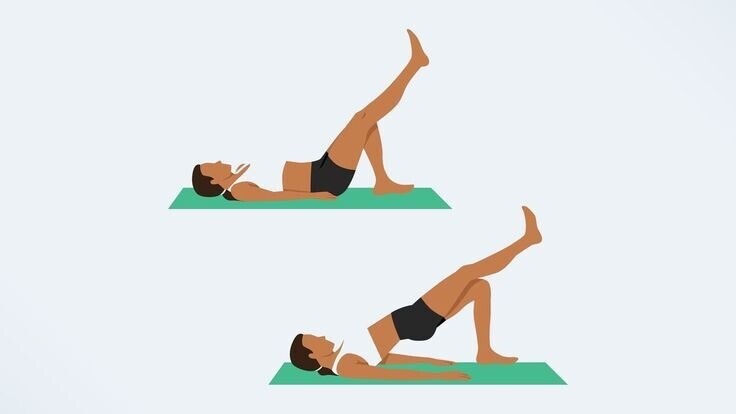
Minute 3: Glute Power: Single-Leg Glute Bridges
The Move: Single-Leg Glute Bridge The "glute-ham" tie-in is where power is generated. Most runners are "quad-dominant," meaning they pull themselves forward rather than pushing. This puts immense strain on the patellar tendon (the knee).
- How: Lie on your back, one leg bent, one leg straight in the air. Drive your heel into the ground and lift your hips.
- The Goal: 15 reps per side. You should feel this in the glute, not the lower back.
Minute 4: The Thoracic Spine (The Breath)
The Move: The "World's Greatest Stretch" (Modified) Triathletes have "Aero-Spine"—a rounded upper back from hours on the aero bars. This restricts lung expansion and leads to neck pain.
- How: From a deep lunge position, put your opposite hand on the floor and reach your other hand toward the ceiling, rotating your chest open.
- The Goal: 5 slow rotations per side. Focus on moving your upper back, not just your arm.
Minute 5: Tendon Durability (The Shield)
The Move: Isometric Calf Holds Tendons do not respond to stretching; they respond to load. The Achilles tendon is the most commonly injured tissue in veteran runners. Isometric holds (holding a position under tension) "quiet" the pain signals and increase tendon stiffness.
- How: Stand on the ball of one foot (use a wall for balance). Lift your heel and hold it in the "mid-range" (not the very top). Hold perfectly still.
- The Goal: 45 seconds per leg.

Why "Boring" Wins Races
I know what you're thinking: “Five minutes? That’s it?”
The secret isn’t the complexity of the moves; it’s the frequency of the stimulus. Tendons have a poor blood supply compared to muscles. They take longer to warm up and longer to heal. By doing these moves daily, you are providing a constant "low-level signal" to your nervous system to keep these tissues resilient.
Think of Pre-hab like brushing your teeth. You don’t brush for three hours on Sunday and expect to avoid cavities. You do it for two minutes twice a day. Your musculoskeletal health follows the same logic.
The 'Red Flag' Assessment: Using the 24-Hour Rule
How do you know if you're on the verge of an injury? Use the 24-Hour Rule:
- Level 1 Pain: Pain that disappears after you warm up. Action: Continue training, but increase Pre-hab.
- Level 2 Pain: Pain that stays the same or gets worse during the run. Action: Stop immediately. Ice/Compress. 48 hours of rest.
- Level 3 Pain: Pain that causes you to change your gait (limping). Action: See a physical therapist. Do not attempt to "run through it."
Conclusion: Longevity is the Ultimate Performance Metric
In the endurance community, we focus on faster. But the fastest athlete who can't start the race is still a "Did Not Start."
The goal of "Infinite Endurance" is to be the 60-year-old at the Ironman World Championships who is still moving with grace and power. That doesn't happen by accident. It happens five minutes at a time, every single day.
Stop waiting for something to hurt. Start bullet-proofing your body today.
| Level | Pain Description | Required Action |
|---|---|---|
| Level 1 | Disappears after warm-up | Continue training; increase Pre-hab |
| Level 2 | Persists or worsens during run | Stop immediately; 48 hours rest |
| Level 3 | Causes limping or gait change | See a PT; do not run |
Summary: Your Daily 5-Minute Pre-Hab Checklist
| Minute | Focus | Exercise |
|---|---|---|
| 0 - 1 | Foot/Shin | Tibialis Raises (25 reps) |
| 1 - 2 | Hip Stability | Standing Fire Hydrants (15/side) |
| 2 - 3 | Glute Power | Single-Leg Glute Bridges (15/side) |
| 3 - 4 | Spine/Breath | World's Greatest Stretch (5/side) |
| 4 - 5 | Achilles Health | Isometric Calf Hold (45s/side) |